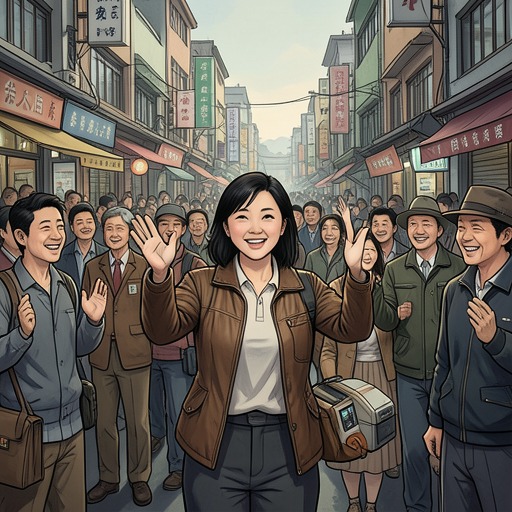
Sophie Ha
Loveboat, TaipeiSophie Ha is Ever Wong’s first close connection in Taiwan and one of the people who makes Loveboat feel at once welcoming and disorienting. From her confident arrival in a tangerine dress to her spirited involvement in the program’s social life, Sophie moves easily through networks that Ever does not yet know how to enter. Her openness offers Ever companionship, but Sophie’s ease also throws Ever’s loneliness, cultural uncertainty, and restrictive family rules into sharper relief. Later, Sophie’s place among the young people around Rick Woo brings her into contact with a different kind of constraint: the stereotypes attached to Asian American men, which the Gang of Five answers through deliberately theatrical self-invention.
Identity and Background
Sophie introduces herself to Ever in the van carrying the students, explaining that she is from Manhattan and now lives in New Jersey. Her parents have separated and sent her to Taiwan for the summer, but she says she would have come regardless. She identifies herself as Korean through her grandfather, making her heritage part of her introduction rather than a fact she conceals. That self-possession contrasts with Ever, who has not yet settled on how to describe her own relationship to Asian American identity.
Sophie is headed to Dartmouth and was a cheerleader at the high school she attended with Rick, her cousin. She is already familiar with the people and connections surrounding the program; Ever, by contrast, feels that everyone knows one another and she knows no one. Sophie’s readiness to speak, joke, and make introductions establishes her as a social bridge, but it does not mean she and Ever experience belonging in the same way.
Friendship with Ever and Loveboat
Sophie’s first conversation with Ever is warm and direct. She asks where Ever is from, learns that she is from Ohio, and responds without hesitation when Ever describes herself as a dancer. Their shared summer begins in a setting where Sophie can make the unfamiliar feel approachable. When she explains that Loveboat is a nickname rather than an actual boat, she treats the term as part of a world Ever has not yet been told how to read, and promises to add its explanation to a list of things to tell her later.
At the mall, Sophie gives Ever a first taste of bubble tea, demonstrating how to pierce the plastic seal and drink the tapioca pearls through a wide straw. Ever finds the texture strange but follows Sophie’s example and likes the drink. Sophie then calls her a Twinkie, using a term for someone perceived as white inside and Asian on the outside. Ever is not angry, but the label leaves her feeling defeated: even among Chinese Americans, she thinks, she is not Chinese American enough. Her homesickness for her sister Pearl intensifies the moment. Sophie’s casual familiarity can include Ever in a new social world, but it can also expose the standards by which Ever feels excluded from it.
Sophie also urges Ever to take advantage of the summer’s freedom. She describes Loveboat as one long party, says the security has tightened, and reports that Rick believes the students can climb a wall to get out. She has been waiting for the trip and wants to meet someone, adding that she is done with the boys she grew up around. When she asks Ever for her own plan, Ever writes the Wong family rules on the back of a Club KISS flyer: straight As, modest dress, a ten o’clock curfew, no drinking, no wasting money, no dancing with or kissing boys, and no boyfriend. The contrast makes the decision Ever writes beneath the list feel momentous: for the summer, she will break those rules. Sophie’s encouragement helps give that rebellion a social setting and an immediate possibility.
Identity, Kinship, and Social Position
Sophie’s connection to Rick is both familial and social. She calls him her cousin, says they went to the same high school, and presents him as someone whose college plans and athletic future are already familiar to her. When she introduces him as headed to Yale to play football, she kneads his shoulder and performs a mock cheer. The teasing establishes their ease with each other, while Ever’s attention to their resemblance and closeness marks Sophie and Rick as a ready-made unit in a setting where Ever is still trying to find her place.
That closeness also gives Sophie a position from which to speak about Rick’s relationships. At a family gathering, she covers smoothly when Xavier’s circumstances come under discussion, then draws attention to Ever as the conversation turns toward her family. Sophie tells the others that Ever’s family is not from Taiwan; Ever explains that her parents migrated from Fujian to Singapore and then to the United States. The exchange places Sophie in a social role that includes helping manage the conversation, while Ever has to explain a migration history that others do not automatically know.
Sophie later offers Ever a pointed account of Rick’s relationship with Jenna. She describes Rick as someone who gives constantly: he drove Jenna places, stayed up talking with her about her worries until three in the morning, and then remained awake to finish his homework. Sophie argues that love should involve equals and mutual give-and-take. She also tells Ever that Rick is trying to transfer from Yale to Williams and that his parents believe Jenna is insisting on it, though Rick presents the idea as his own. Ever is surprised by the news and recalls that Rick has rarely discussed Yale directly. Sophie’s account makes visible the emotional labor and pressure behind Rick’s choices, even as Ever’s response reveals how personally she has begun to take an interest in him.
Asian American Identity and Stereotypes
When a conversation turns to identity, Sophie describes herself as Asian American and part Korean. Asked about her own identity, Ever admits that she has not thought much about it: she has considered herself American and had not wanted much to do with her Asianness before arriving in Taiwan. In Ever’s account, the experience of being among Asian Americans has a double effect. At a mall back home, people sometimes turned to look at her family; in Taiwan, her Asian Americanness seems to disappear into the crowd, bringing unexpected relief. That relief coexists with the later sting of being called a Twinkie, showing that visibility and belonging are not simple opposites.
Sophie’s social circle also includes the young men who challenge stereotypes of Asian masculinity. In Chinese Medicine, Marc, David, and Sam call themselves the Angry Asian Men and list the types they want to contest: the kung fu master, the nerd engineer who follows rather than leads, and the effeminate Asian man presumed unable to get a girlfriend. Marc jokes about David’s goatee while urging him to own the stereotype, and Sam declares that they need to take these representations back. Their campaign is comic, but the list names a set of expectations that the men experience as constricting rather than harmless.
Sophie helps make the larger social context around that campaign visible. She and Rick belong to the same circle of cousins and friends that includes the students who will turn the stereotype into a performance. At the National Palace Museum, Marc and David and the others stage a human pyramid in the rain; Marc explains that they are taking back their stereotypes. Their action shifts the campaign from talk to public display, a physical joke that makes the men’s bodies part of the argument.
The Gang of Five and the Beauty Contest
The campaign reaches its largest public expression at the Ms. Chien Tan Beauty Contest. A warm-voiced emcee introduces contestants with playful stage names, and the audience responds with cheers and whistles. Among the contestants are Marc, Sam, David, Benji, and Peter, identified as the Gang of Five. They take up the effeminate Asian male stereotype on their own terms, transforming a label used to diminish them into the premise for an intentionally exaggerated spectacle.
The contest runs well past its allotted time as the contestants strut and the audience votes. The final round comes down to Ben-Jammin’ and Marquette. Marquette removes a fur coat to reveal a faux-skin leotard and the Dragon’s green qipao; the Dragon, who is watching from the front row, rises in her matching qipao and joins the celebratory display. Marquette is crowned, and the others lift him onto their shoulders as confetti is tossed. The scene’s reversal depends on more than the contestants’ costumes: the program authority figure participates rather than suppresses the joke, and the audience’s applause makes the reclaiming collective.
Ever watches the scene with Sophie, takes her hand, recognizes Marc and David, and is swept up in the performance. Her excitement carries a note of absence as she thinks that Rick should be there to see it. Sophie’s presence beside her links the contest’s playful defiance to the friendships and social world through which Ever has been learning to belong. The Gang of Five’s performance does not erase the stereotypes it invokes, but it changes who controls the staging: instead of receiving the label passively, the men make it theatrical, communal, and funny. Sophie’s part in this arc is not to lead the contestants but to inhabit the network around them, where identity is debated, performed, and tested in public.